If you or a family member in Pakistan needs hospital treatment, chances are someone has already told you: "check if you have a Sehat Sahulat card." It is one of the largest government health insurance schemes in the world, yet very few families understand exactly who qualifies, what it actually pays for, and where its coverage quietly runs out. This guide explains all three — plainly, without the bureaucratic language.
- Free inpatient treatment for eligible families — no premium, no fee
- Common annual family limit: around PKR 1,000,000
- Check your status instantly: SMS your CNIC to 8500
- Covers admitted (inpatient) treatment only — not outpatient visits or routine medicine
- Active in Punjab, Khyber Pakhtunkhwa, and several other provinces, with province-wide rollout still expanding
What Is the Sehat Sahulat Programme?
The Sehat Sahulat Programme (formerly the Sehat Insaf Card) is a government-run health insurance scheme active in Punjab, Khyber Pakhtunkhwa, and several other regions of Pakistan. It is designed to give every eligible family free inpatient treatment at government and selected private hospitals, without paying anything at the counter. Instead of the family paying and claiming reimbursement later, the hospital bills the government's insurance fund directly.
The programme was rolled out province by province, starting in Khyber Pakhtunkhwa before expanding into Punjab and beyond. Coverage limits and the exact list of empanelled hospitals differ slightly by province, so the first step for any family is always to check locally.
Who Is Eligible for a Sehat Sahulat Card?
- Every household already listed in the Benazir Income Support Programme (BISP) database
- Families falling under the poverty line as measured by the National Socio-Economic Registry (NSER)
- Government employees in certain pay scales, added under separate coverage tiers in some provinces
- In Punjab, coverage has been extended to nearly all CNIC holders province-wide — check your district's specific rollout status
- Newborns and dependents registered under the head of household's CNIC
How to Check If You Are Registered
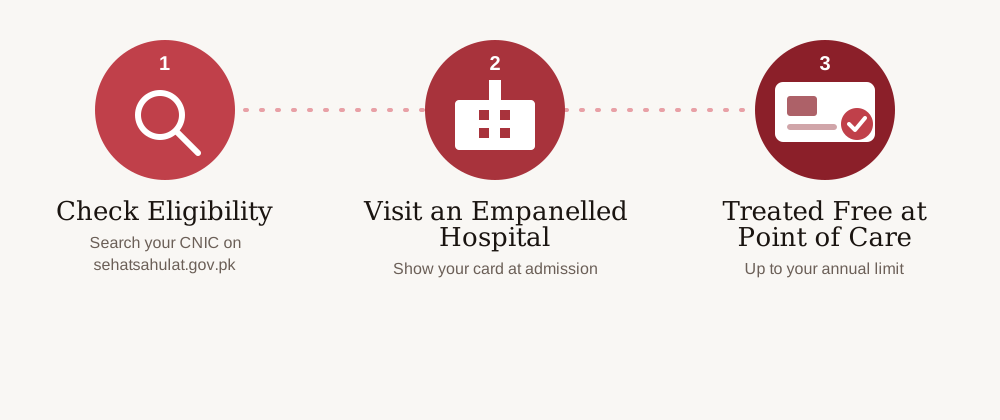
Checking your eligibility takes less than a minute and does not require visiting an office. Send your 13-digit CNIC number by SMS to 8500, or visit the official portal at sehatsahulat.gov.pk and enter your CNIC into the eligibility checker. You will receive an immediate reply confirming your coverage status, your annual limit, and nearby hospitals where the card is accepted. If your family is not showing as eligible but you believe you meet the criteria, you can register through your nearest NADRA office or a Sehat Sahulat registration desk.
What the Card Actually Covers — And What It Doesn't
The clearest way to see the boundary is side by side. This is the single most common source of confusion families run into mid-treatment:
| Situation | Sehat Sahulat |
|---|---|
| Admitted (inpatient) surgery, maternity, accidents, emergencies | Covered |
| Cancer treatment and dialysis at empanelled hospitals | Covered, up to annual limit |
| Cardiac procedures (bypass, angioplasty) at listed hospitals | Covered, up to annual limit |
| Diagnostic tests as part of an admitted stay | Covered |
| Outpatient doctor consultations | Not covered |
| Take-home medicine after discharge | Not covered |
| Long-term chronic care outside a hospital admission | Not covered |
| Travel or accommodation near a treatment centre | Not covered |
| Treatment cost once the annual family limit is reached | Not covered |
Assuming the card works like a normal health insurance policy that also covers clinic visits and prescriptions. It doesn't — Sehat Sahulat is built around hospital admission. If you're not admitted, it generally doesn't apply, no matter how serious the condition.
What It Does Not Cover — The Real Gap
This is the part most families only discover once treatment is already underway. Once a family reaches its annual limit — which happens quickly with cancer or dialysis, both requiring repeated, ongoing treatment — the card simply stops paying, leaving the family to cover 100% of further cost themselves. Even where the card is accepted, waiting lists at empanelled hospitals for procedures like cardiac surgery can run for months, time some patients do not have.
The card pays for a portion of one hospital stay. It was never designed to cover a year of chemotherapy, a lifetime of dialysis, or the months a family spends unable to work while caring for a sick child. That is the gap we exist to close.
Quick Self-Check: Do You Need Help Beyond the Card?
- Your family's annual Sehat Sahulat limit has already been used this year
- Your treatment (chemotherapy, dialysis, chronic disease management) requires ongoing care beyond a single admission
- Your district's rollout hasn't reached full coverage yet, or your application is still pending
- You need outpatient medication, travel, or accommodation costs covered — none of which the card pays for
- Your hospital isn't on the empanelled list and you can't reasonably transfer care
How PulseGivers Helps When the Card Runs Out
PulseGivers is built specifically for patients who fall into this gap — verified, in treatment, but no longer covered. If your Sehat Sahulat limit has been exhausted, or your treatment falls outside what the card pays for, you can apply for direct support and our team will review your case within five working days. Read our companion guide on how to find financial help for medical treatment in Pakistan for a full breakdown of government schemes, NGOs, and real treatment costs.
Is the Sehat Sahulat card free?
Yes. There is no premium or application fee for eligible families — it is fully funded by the government.
Can I use my Sehat Sahulat card at any hospital?
No. It only works at hospitals empanelled in the programme. Check the current list on sehatsahulat.gov.pk or by SMS to confirm before you travel to a hospital.
What happens when I reach my annual limit?
The card stops covering further inpatient costs for that year. You will need to pay directly, or seek other support, until the limit resets the following year.
Does the card cover medicine after I'm discharged?
Generally no. Take-home medication after an inpatient stay is usually not covered — only medicines administered during the admission itself.
Is Sehat Sahulat the same as the Sehat Insaf Card?
Yes. Sehat Insaf Card was the original name under the Khyber Pakhtunkhwa government; the scheme is now branded the Sehat Sahulat Programme nationally.
Have you exhausted your Sehat Sahulat limit or don't know where else to turn?
Apply for Help →